
Why Local Charlotte Businesses Need AI Search Optimization
TL;DR: As more people ask conversational questions directly to AI tools like ChatGPT, Perplexity, and Google AI Overviews, traditional search methods are changing rapidly. Generative Engine Optimization (GEO) is the practice of organizing your website so these AI answer engines can easily read, trust, and cite your business. For local Charlotte companies, adopting GEO now ensures that when prospective clients ask AI for a local service recommendation, your business is the one suggested.
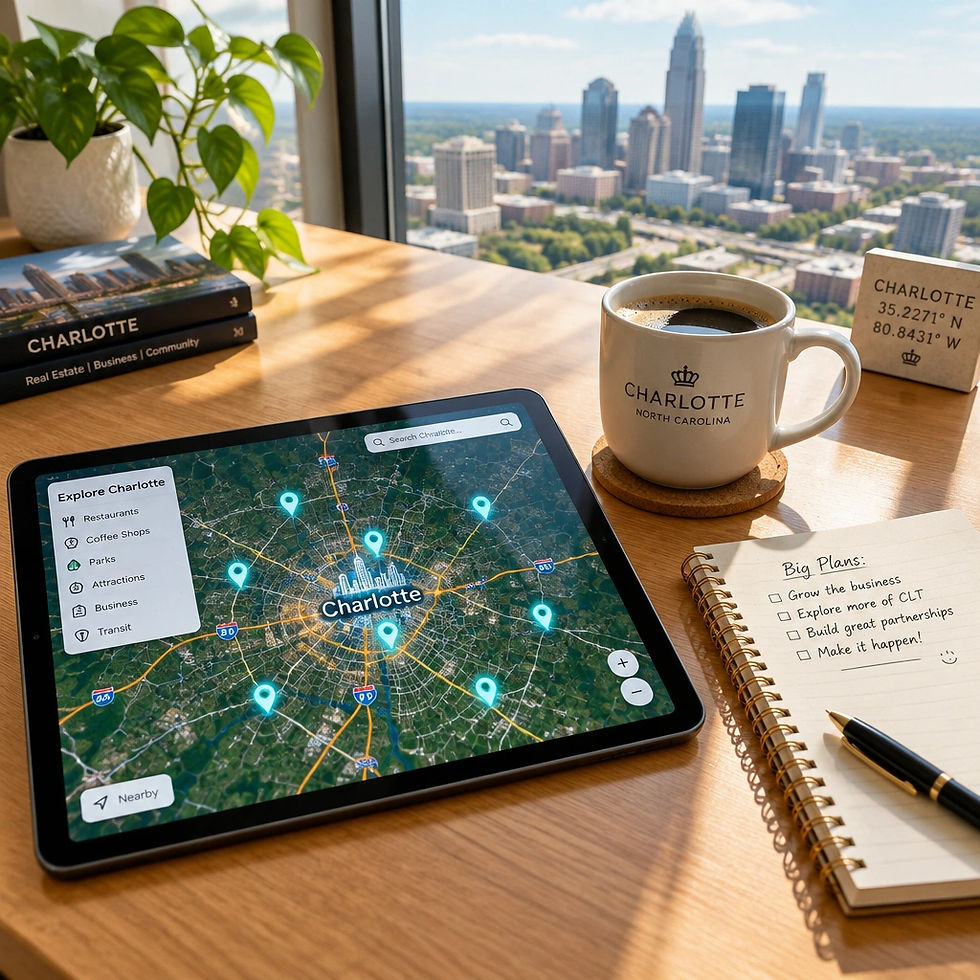
The way local customers in Charlotte find services is undergoing a fundamental shift. For decades, when a homeowner in South End needed a plumber, or a business owner in Ballantyne searched for an accountant, they typed a short phrase like "best accountant Charlotte NC" into a search bar. They were presented with a long list of blue links, clicked on a few websites, and compared options manually.
Today, consumers increasingly skip the list of links altogether. Instead, they turn to AI tools like OpenAI’s ChatGPT, Perplexity, and Google’s AI Overviews to get immediate, direct answers. A customer might now type, "Who is a reliable, family-owned electrician near Myers Park that handles historic home rewiring?"
In seconds, the AI synthesizes information from across the web and presents a single, tailor-made answer naming specific businesses.
If your company is not visible within those AI-generated answers, you miss out on high-intent local clients. To stay competitive in the Queen City, local business owners must understand Generative Engine Optimization (GEO), the process of structuring your online presence so AI engines easily understand, cite, and recommend your services.
1. What Is Generative Engine Optimization (GEO)?
Traditional search engine optimization (SEO) focused heavily on getting your website to rank at the top of a search results page for specific keywords. Generative Engine Optimization (GEO) builds on that foundation, but focuses on how Large Language Models (LLMs) and AI answer engines read and process information.
Instead of just matching keywords, AI tools read web content to understand real-world concepts, facts, and relationships. When a user asks an AI engine for a local business recommendation, the AI acts like a high-speed research assistant:
It scans multiple sources: The AI reads website copy, customer reviews, local directory listings, and news articles simultaneously.
It evaluates credibility: It checks whether your business details are consistent and supported by clear facts.
It synthesizes a direct response: Rather than giving the user ten links to read, it writes a custom summary recommending the best options.
GEO is the practice of making your business's online information so clear, accurate, and easy to parse that AI tools confidently select your company as the top answer.
2. Why Charlotte’s Growing Market Makes GEO Essential
Charlotte is one of the fastest-growing business hubs in the United States. With rapid population growth across neighborhoods like NoDa, Plaza Midwood, South End, and surrounding areas like Huntersville and Matthews, local competition across home services, legal practices, healthcare, and B2B consulting is at an all-time high.
Because the Charlotte market is growing so quickly, traditional keyword strategies are becoming crowded and expensive. GEO gives local businesses a powerful way to stand out for several key reasons:
AI Tools Value Local Context
When someone in Charlotte asks an AI for a recommendation, the AI looks for specific geographic proof. A website that explicitly mentions local landmarks, service boundaries, and regional experience stands out to AI models over generic national competitors.
High-Intent Customers Use AI Search
People who ask AI engines for local business recommendations are rarely just browsing. They usually have a specific problem, a specific location in mind, and a readiness to hire. Winning the AI recommendation puts your business directly in front of the most qualified leads.
Early Adopters Gain a Lasting Advantage
While thousands of local companies compete for traditional search terms, very few Charlotte businesses have intentionally formatted their web content for AI search engines. Building an AI-friendly web presence today establishes your brand as an early authority in the local market.
3. How AI Search Engines Evaluate Local Businesses
Understanding how AI tools select which businesses to recommend helps you format your website effectively. AI answer engines prioritize four core pillars when evaluating local companies:
Clear, Direct Answers (Answer-First Formatting)
Verified Local Details (Consistent NAP & Locations)
Detailed Customer Proof (Specific Reviews & Stories)
Structured Data (Clean Lists, Tables & Headings)
Direct, Fact-Based Writing
AI tools prefer web content that gets straight to the point. Web pages that open with clear, self-contained summaries (the "answer-first" model) are significantly easier for AI engines to quote directly than pages filled with vague marketing slogans.
Consistent Business Details
AI platforms want to avoid recommending closed or fake businesses. They cross-check your business name, address, phone number, and service areas across your website, Google Business Profile, local chamber of commerce pages, and review platforms. If all details match perfectly, the AI trusts your business.
Specific Customer Reviews
AI engines do not just count stars; they read the text inside your customer reviews. A review that mentions your specific service and neighborhood (e.g., "They installed new quartz countertops in our South Park home on time") provides rich, verifiable proof that AI algorithms look for when answering localized questions.
4. Simple Steps to Make Your Website AI-Ready
You do not need an engineering background or complex technical software to optimize your website for AI search engines. Applying simple, human-friendly formatting habits across your web pages makes a substantial difference.
Write Headings as Real Questions
Structure your web pages using clear subheadings that mirror how real people speak to AI assistants.
Instead of a heading like "Our Services," use "What commercial roofing services do we offer in Charlotte?"
Instead of "Why Us," use "Why do Charlotte homeowners choose our plumbing team?"
Organize Facts into Tables and Bulleted Lists
AI engines parse structured information much faster than dense paragraphs of text. Use simple visual structures across your service pages:
Use bulleted lists to highlight core service benefits, step-by-step processes, or team credentials.
Use tables to compare service packages, pricing levels, or local coverage areas side by side.
Keep Paragraphs Focused and Self-Contained
When an AI engine retrieves an answer from your website, it often grabs a single paragraph. Make sure every paragraph on your site makes complete sense on its own by naming your business, specific services, and locations explicitly rather than using generic words like "it," "they," or "this."
5. Combining Traditional Local SEO with GEO
Generative Engine Optimization does not replace traditional local marketing; it enhances it. The most successful Charlotte businesses combine both strategies to cover all bases:
Your Google Business Profile provides verified geographic coordinates and customer ratings.
Your Local Citations (like local chamber listings and trade directories) reinforce your community footprint.
Your Website Content provides the rich, structured answers that AI tools pull from when writing custom recommendations for users.
When these three elements work together, your business builds a solid foundation of trust that satisfies both traditional search crawlers and modern generative answer engines.
Conclusion
The shift toward AI-powered search is not a distant trend—it is happening right now across Charlotte and beyond. Prospective clients are increasingly turning to tools like ChatGPT, Perplexity, and Google AI Overviews to find fast, trustworthy local recommendations.
By adopting Generative Engine Optimization (GEO) principles today, writing clear answers first, using question-based headings, organizing information into simple lists and tables, and maintaining consistent local details, you ensure that your business remains easy to find, easy to trust, and ready to be recommended.